
Student-athletes talk mental health
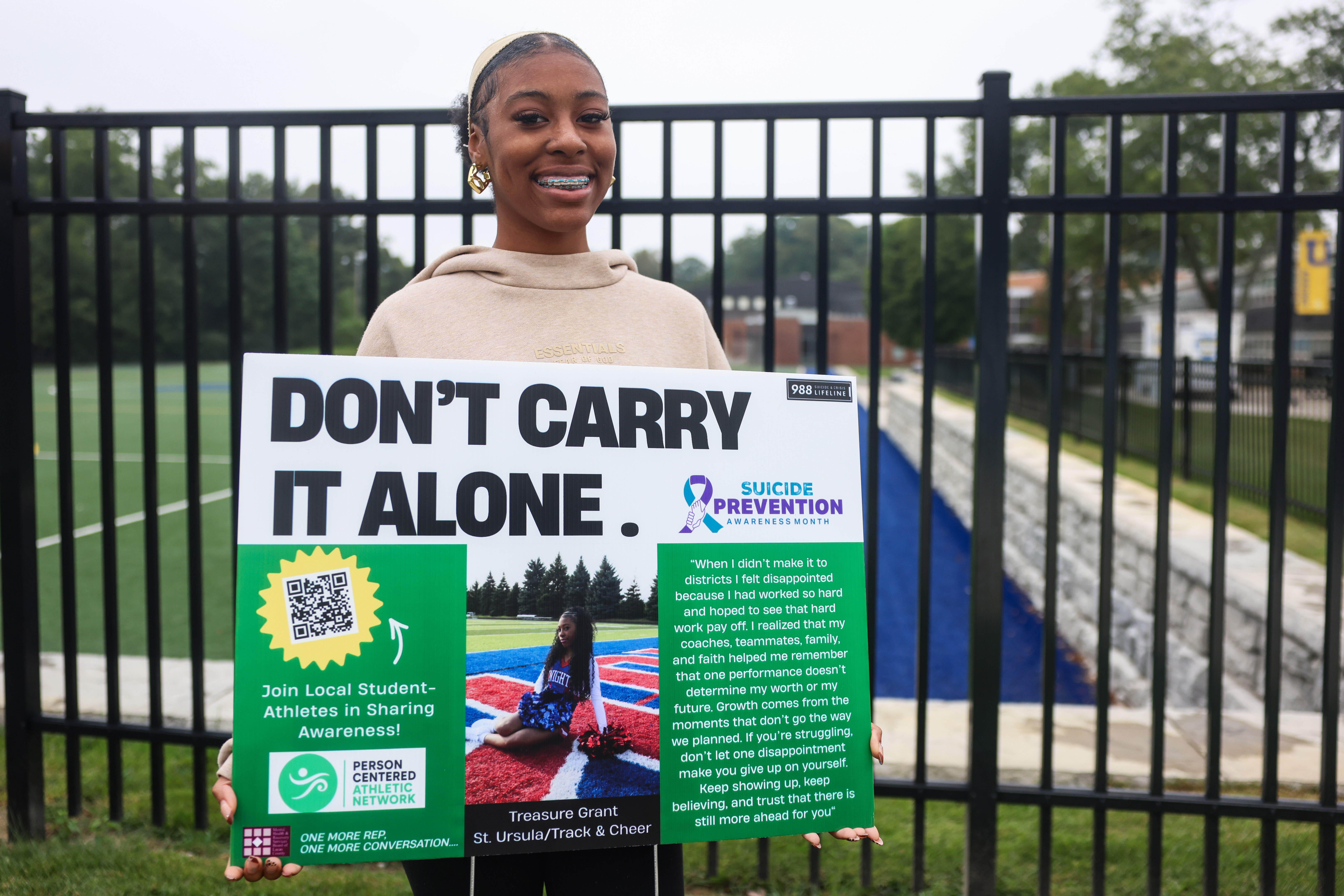
Treasure Grant was going through the hardest time of her life after losing her 18-year-old sister, but the St. Ursula Academy student-athlete did something that can be difficult for young athletes accustomed to pushing through: She asked for help.
“I had lost my sister, and I literally was going through so much, but I leaned on those around me,” said Treasure, 17, a senior who participates in track and cheerleading. “I talked, and I opened up about what I was going through.”
Treasure, whose sister Savanna Jones died in an alleged hazing incident at Wilberforce University, found support from her coaches, family, and friends. Now she is lending her voice to a campaign encouraging other student-athletes not to struggle alone.
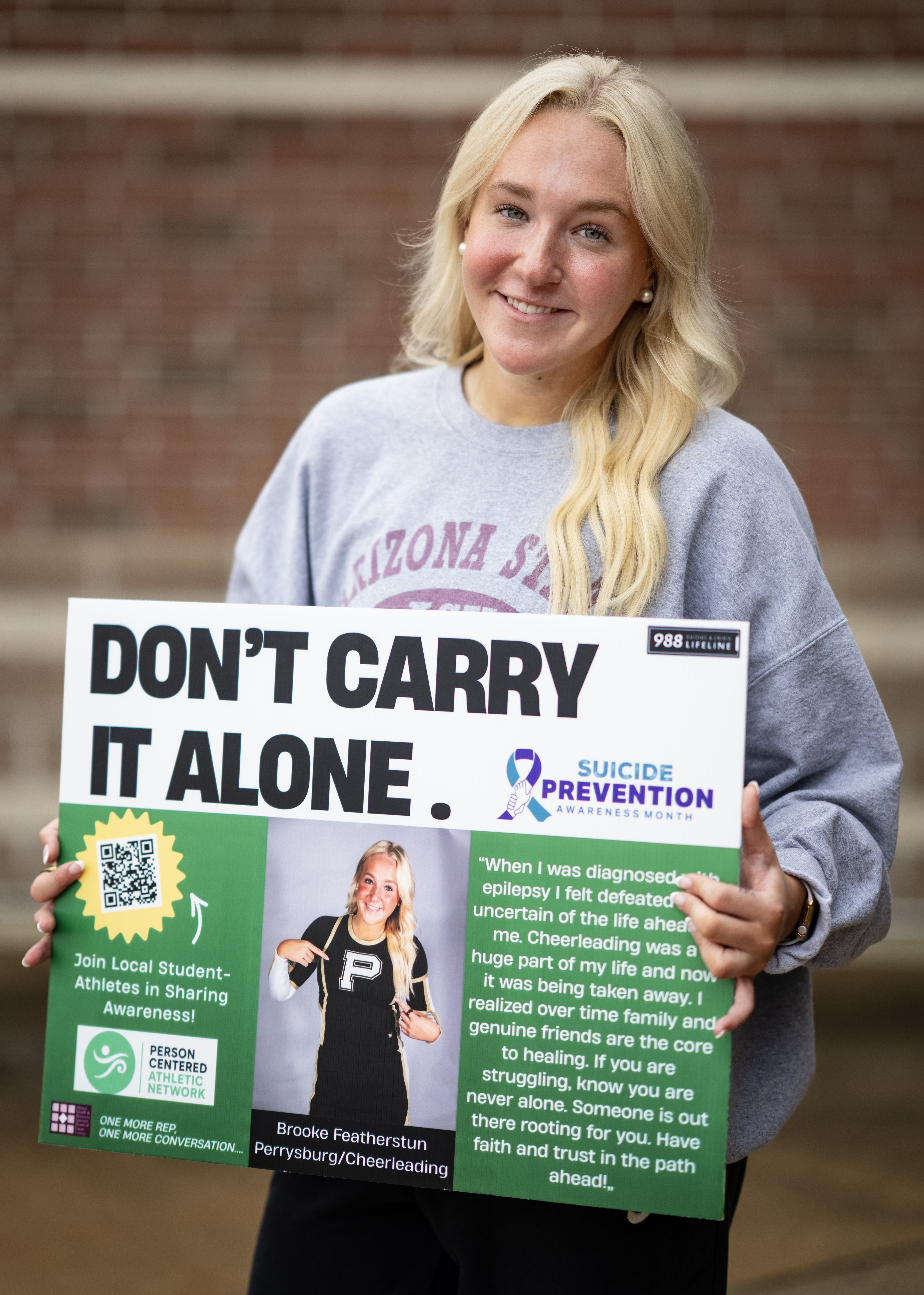
The Person Centered Athletic Network, founded by St. Ursula graduate Aubrey Massey, 18, has launched One More Rep, One More Conversation, a suicide-prevention campaign featuring local student-athletes on yard signs throughout the Toledo area.
The signs pair photographs of the athletes with personal messages about mental health, encouraging other teens to talk to someone when they are struggling.
Student-athletes can face intense pressure to perform while also feeling expected to appear strong, making it difficult for some to speak openly when they are struggling with their mental health.
Beginning in early September, the One More Rep, One More Conversation yard signs were placed in front yards, near school entrances, and at YMCAs and community centers across Toledo.
The effort focuses on a simple message: Do not carry it alone, because one more conversation can make a difference.
Treasure has a sign at the YMCA near Start High School that reads in part: “I realized that my coaches, teammates, family, and faith helped me remember that one performance doesn’t determine my worth or my future.”
“Not carrying that load alone personally means to me that if you’re feeling something, and you need to take that time to yourself, it’s OK to take a pause to let the world happen because it’s going to happen,” Treasure said. “Lean on those around you — your friends, your family, your coaches. Let your friends be there. Don’t isolate yourself.”
PCAN works to empower student-athletes, provide spaces for honest conversations about mental health, and connect teens with resources, including its annual Athlete Mental Health Summit.
“I realized that a lot of people who were stars in their sport weren’t happy, and that’s just something you typically don’t expect if you’re successful — to not be happy with what you’re doing,” Ms. Massey said.
Brooke Featherstun, 17, a senior at Perrysburg High School who participates in cheerleading, serves as co-director of operations and a key organizer of PCAN. Her sign is located at Fort Meigs YMCA in Perrysburg.
After she was diagnosed with epilepsy in her freshman year, Brooke said she struggled with understanding how to go on with her athletics and felt compelled to open up about those struggles.
“I’m very much a person that feels nothing needs to be hidden and everything needs to be said. And athlete mental health can be very much shunned upon in a way,” she said.
Brooke said that expectation of strength can make it particularly difficult for athletes to acknowledge when they are struggling.
“Athletes are expected to be strong all the time in individual and team sports. And I think what people don’t realize sometimes is that being strong also means having strong mental health and not just strong physical health,” Brooke said.
She sees the yard signs as a starting point for these kinds of conversations.
“We do see a lot of athletes that share their stories through the suicide prevention campaign, and you start to realize just how much people go through, and how much that they really truly are human underneath all this perfect cover of being an athlete,” she said.
In Ohio, 245 people ages 5 to 24 died by suicide in 2024, according to the Ohio Suicide Prevention Foundation. Suicide is the second-leading cause of death among children ages 10 to 14, and nearly 20 percent of high school students report seriously considering suicide, while 9 percent report attempting it.
The campaign runs throughout September, with a community celebration set for October to recognize the local high school student-athletes who participated and helped bring the campaign to life.
The signs also include a QR code inviting other teens to join the effort and information about the 988 Suicide & Crisis Lifeline.
Student-athletes interested in participating can sign up online or email aubrey.pcan@gmail.com for more information.
Contact Sheila Howard at showard@theblade.com.