
Rotary Club tackles housing

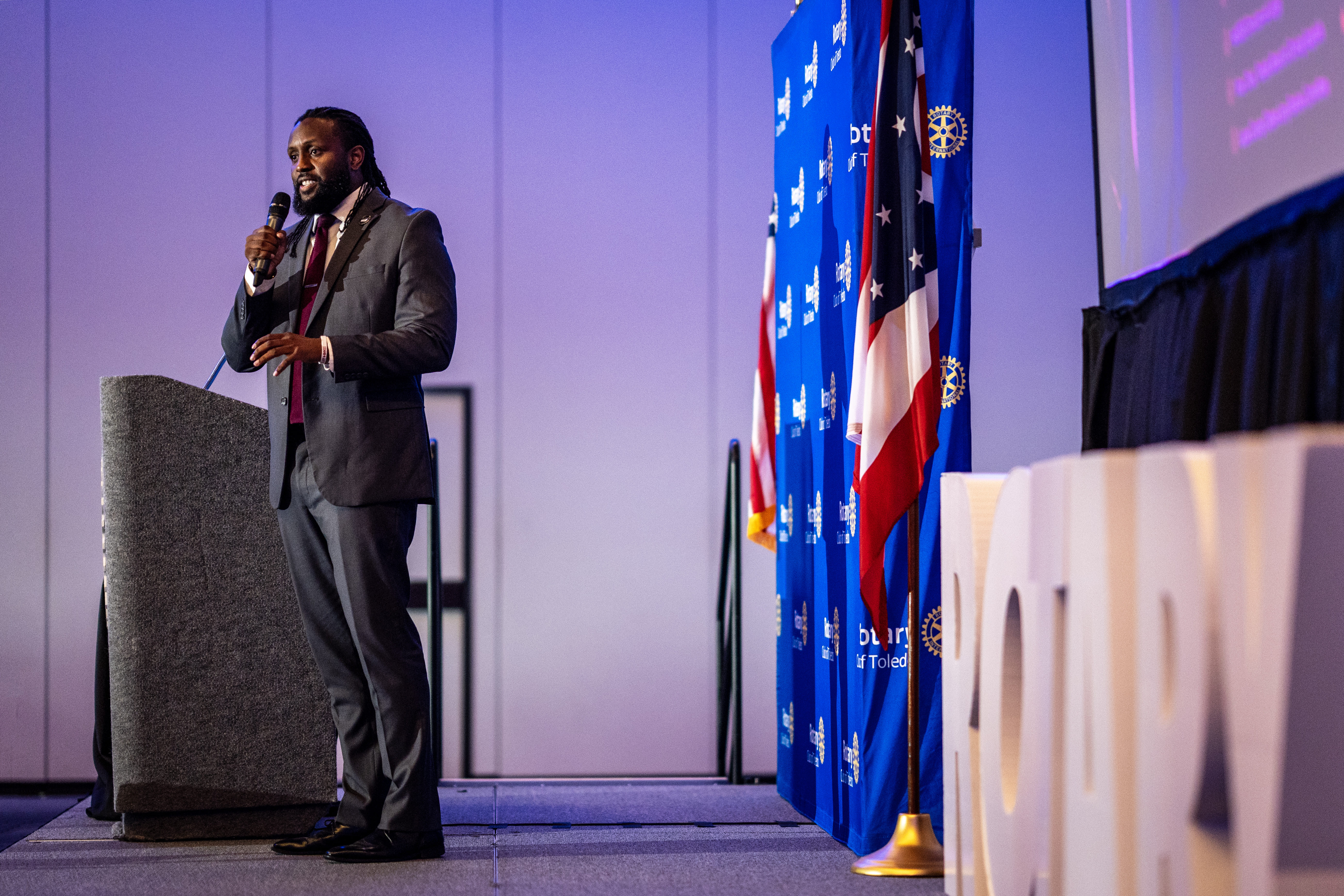

Low supplies, high out-of-state investor rates, and legislative obstacles continue to strain Toledo’s affordable housing market.
But a local Realtor sees abundant paths toward a long-term solution.
“We can create a Toledo where Toledoans can own Toledo,” said Rob Pasker, owner of Pasker Real Estate and president of the Ohio Realtist Association. “Everyone should own something. Own your land, own your home.”
Mr. Pasker joined the Rotary Club of Toledo for a Monday presentation examining hurdles to affordability and homeownership in northwest Ohio’s housing market, highlighting solutions that every sector can contribute to.
“There is a huge need right now, and I believe we need to ring the alarm,” Mr. Pasker said.
Creating a stable community and a healthier environment for the youth often begins with owning one’s home.
“Wealth is protection, wealth is opportunity,” he said. “People use the equity in their homes to educate their children. Some people use it to invest in their businesses, creating strings of income themselves.”
On average, he said, homeowners have better long-term physical and mental health, quality of life, and higher incomes.
But Toledo is on the brink of becoming a renter-majority city, meaning most may not experience the stability and long-term wealth that come with homeownership.
Despite increases in property tax and insurance, interest payments on homes remain the same under fixed-rate mortgages after purchase, hedging owners from rampant inflation.
“I just want to see a Toledo where we make sure that the people that live here can take advantage of these properties,” he said.
Affordable, but not attainable
In 2025, the Wall Street Journal and Realtor.com named Toledo the No. 1 housing market in America based on economic health and real-estate fundamentals.
Today, the national median price of homes is about $412,000. The median sales price in Toledo is $147,500, while the average is $163,832.
“I was very encouraged when he showed the stability of home prices,” said Travis Tangeman, former club president.
The biggest hurdle to prospective homeownership in Toledo isn’t skyrocketing costs, but limited inventories, Mr. Pasker explained. In 2016, Toledo had about 1,800 houses on the market. This year, it has 775.
“This is drastically low. It’s actually emergency-levels low,” he said.
Many attendees were surprised to hear about the historic shortage.
“For the longest time, we were the cheaper market. We were the place where you can get a home for less than 100,000,” said Monique Ward, a Rotary Club member. “But I can’t believe that we don’t have a lot of houses for sale, because you would think we’re not the biggest city.”
A sharp post-pandemic increase in interest rates deterred homeowners from buying and moving. That in turn stopped people from selling their houses. Market conditions were characterized by historically low supply, contributing to rising competition and limited access to affordable options for first-time homebuyers.
“When you have low supply and higher demand, you’re going to see higher prices, and you’re going to see faster transactions,” Mr. Pasker said.
Toledo officials have stressed the need to increase population, create a larger tax base, and expand local businesses to revitalize the city’s economy, Mr. Pasker said. But more housing units are required for such economic growth to take permanent effect.
Mr. Pasker called for legislative changes to modernize rules governing small residential projects, which he said would make constructing affordable housing units easier, increasing supplies people can reasonably attain.
Legacy zoning laws, such as minimum lot sizes and parking mandates, create regulatory barriers to smaller, higher density housing, driving up initial development costs and delaying construction timelines, he said.
“We do have rules in place in northwest Ohio that make it unfeasible to build affordable, attainable properties,” he said. “I don’t think the government should serve as an impediment to that type of development.”
Collaboration needed
The region’s rising out-of-state investor ownership rates have also created volatile market conditions for home buyers.
Local buyers’ offers are being edged out by out-of-state buyers who purchase uber-affordable properties with cash, Mr. Pasker said. “Lucas Coun-ty is off the charts as far as investor activity. There’s already not enough properties for sale, but with the attention we got nationally, we have people from all over the world coming in to buy our property,” he said.
Mr. Pasker also noted that the 15,000 empty homes in northwest Ohio can present opportunities for infill developments.
Progress occurs when policy, capital, construction, and residents work toward a joint solution to the housing crisis, he said.
“Toledo’s at a point where it needs smart, assertive people to stand up and stand for something,” Mr. Pasker said. “They can make true differences.”
Contact Kelly Kong
at kkong@theblade.com.